


The Floating World: A Selection and Description of Seven Japanese Edo-Period Prints
- Alexandre

- Apr 22, 2022
- 7 min read
Updated: Sep 14, 2022
Here is a selection of seven Edo-period woodblock prints I chose and did a commentary on for a project I worked on a while ago. I decided to share it so that others can appreciate the depth of detail that goes into these paintings.
Ukiyo (浮世, "floating, fleeting, or transient world") describes the urban lifestyle, especially the pleasure-seeking aspects, of the Edo-period Japan (1600–1867). The Floating World culture developed in Yoshiwara, the licensed red-light district of Edo (modern Tokyo), which was the site of many brothels frequented by Japan's growing middle class. A prominent author of the ukiyo genre was Ihara Saikaku, who wrote The Life of an Amorous Woman. The ukiyo culture also arose in other cities such as Osaka and Kyoto.
The famous Japanese woodblock prints known as ukiyo-e, or "pictures of the Floating World", had their origins in these districts and often depicted scenes of the Floating World itself such as geisha, kabuki actors, sumo wrestlers, samurai, chōnin, and prostitutes.
The term ukiyo (when meaning the Floating World) is also an ironic allusion to the homophone ukiyo (憂き世, "sorrowful world"), the earthly plane of death and rebirth from which Buddhists sought release.
In its modern usage, the term ukiyo - "the floating world" - refers more to a state of being: living in the moment, being detached from the bothers of life.

月百姿: 四條納涼 Tsuki hyakushi: Shijō nōryō 100 Aspects of the Moon: Cooling off at Shijo
Yoshitoshi Tsukioka (月岡 芳年; 1839 - 1892), 1885
Yoshitoshi (1839 - 1892) is one of ukiyo-e’s most prolific figures, recognised as the last great master of the art form before its decline following the Meiji Restoration. He spent his life in Edo (the former name for Tokyo, “the eastern capital”) and was admired for his artistic vision, which incorporated many different colours and themes and was not afraid to venture towards grotesque themes. In this print, a geisha is seen cooling herself down in the Summer heat by dipping her feet into the Kamo river, which flows through the old capital city of Kyoto (“the capital city”) - which was modeled on the Chinese Tang-dynasty capital of Chang’an and remained capital of Japan until the imperial court moved to Tokyo in 1869. Geisha were female entertainers (not prostitutes, contrary to popular opinion), and would’ve been a common sight on Shijo (“Fourth Avenue”), which was a bustling street in the summertime rife with teahouses, restaurants, booths and dance troops which led down towards the river. The act of cooling off on Shijo riverbank (Shijogawara no suzumi) became a common practice in the Summer throughout the Meiji period. This piece also presents a certain element of intimacy, with her red under-kimono showing.

羅城門 渡辺綱 鬼腕斬之図 Rashomon Watanabe no tsuna oniudekiri no zu Watanabe Tsuna Cutting Off the Demon's Arm at the Rashomon Yoshitoshi Tsukioka (月岡 芳年; 1839 - 1892), 1887
Yoshitoshi (1839 - 1892) is one of ukiyo-e’s most prolific figures, recognised as the last great master of the art form before its decline following the Meiji Restoration. He spent his life in Edo (the former name for Tokyo, “the eastern capital”) and was admired for his artistic vision, which incorporated many different colours and themes and was not afraid to venture towards grotesque themes. This print depicts the warrior Watanabe no Tsuna (953-1025) - lieutenant to the famous servant of the Fujiwara clan Minamoto Yorimitsu (948-1021) - confronting the legendary Heian-period demon Ibaraki-dōji during a furious rainstorm at the ancient gate of Rashomon, outside the Imperial Palace in Kyoto. This is a legendary battle that has featured in four books and five plays, based around Minamoto Yorimitsu and his comrades in the lawless and disorderly times of the 11th century, where they often fought demons. In one hand, Watanabe carries a banner with his name on it, which he will soon discard in favour of his sword, which will cut off the demon's arm - earning it the moniker Onikirimaru (“demon cutter”).

雪中富士川之図 Secchū Fujikawa no zu A snowy gorge on the Fuji River
Utagawa Hiroshige (歌川広重, 1797 - 1858), 1842
Hiroshige (1797 - 1858) is one of ukiyo-e’s most well-known figures. He was of samurai background and spent his life in Edo (the former name for Tokyo, “the eastern capital”) as part of the Utagawa school of ukiyo-e and stood out among other ukiyo-e artists by focusing more on landscapes and scenery than the scenes of pleasure in urban Edo - particularly centered around pretty women and famous actors. This print is an example of the latter, and appears to have been intended to act as a hanging scroll for display in the home, likely inspired by Hiroshige’s travels along the Fuji river. Despite being famous for this kind of print, he only started painting landscapes around 1830, inspired by the scenery on his travels. There is a strong influence from Chinese landscape painting in the depth and style of this painting, which relies more on the latter elements than on colour, as is often the case in other ukiyo-e paintings. Landscape paintings were traditionally considered the highest form of Chinese painting in China, and were closely linked with the philosophy of Daoism, which emphasises finding harmony within the natural world, hence the emphasis on natural scenery over human imagery and losing oneself in said scenery. Mountains feature heavily in these kinds of paintings, as they reached high up into Heaven and were therefore seen as having religious significance, making the contemplation of mountains good for the soul of the observer.
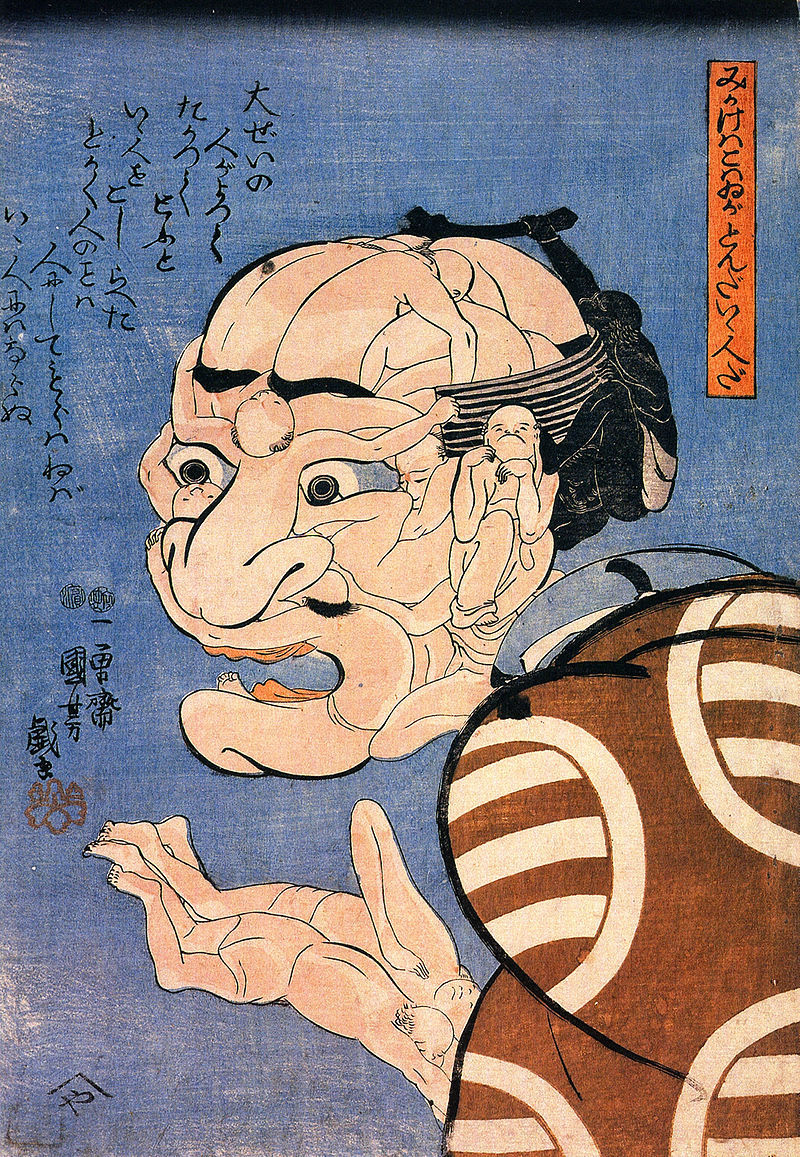
みかけハこハゐが とんだいゝ人だ Mikake ha ko ha ru ga tonda ii hito da At first glance he looks fierce, but he is really a kind person Utagawa Kuniyoshi (歌川 国芳; 1798 - 1861), 1847
Kuniyoshi (1798-1861) is one of ukiyo-e’s most legendary figures, having produced some of its most iconic and unique works as well as having been the teacher of another famous ukiyo-e artist, Yoshitoshi (1839 - 1892), even giving his pupil his moniker. Son of a dyer, his skills were noted when he was only twelve years old by fellow Utagawa school painter Toyokuni Utagawa, and was later admitted to his studio. Kuniyoshi was capable of painting a variety of themes, but his most noteworthy success was in the domain of giga (caricatures), which included pictures of actors and even satirical depictions of governmental figures. He was also well noted for his use of visual trickery, with prints such as this one demonstrating a caricature of a man whose body is made out of miniature people in a way that recalls the work of 16th-century Italian painter Giuseppe Arcimboldo. Kuniyoshi’s imaginative ability was certainly well noted.

相馬の古内裏 妖怪がしゃどくろと戦う大宅太郎光圀 Sōma no ko dairi yōkai gashadokuro to tatakau ōya Tarō Mitsukuni Princess Takiyasha Calling up a Monstrous Skeleton Specter at the Old Palace in Sōma Utagawa Kuniyoshi, (歌川 國芳, 1798 - 1861), c. 1845-46
Kuniyoshi (1798-1861) is one of ukiyo-e’s most legendary figures, having produced some of its most iconic and unique works as well as having been the teacher of another famous ukiyo-e artist, Yoshitoshi (1839 - 1892), even giving his pupil his moniker. Son of a dyer, his skills were noted when he was only twelve years old by fellow Utagawa school painter Toyokuni Utagawa, and was later admitted to his studio. This print is an iconic one, depicting the 10th-century princess Takiyasha reading a spell from a scroll and summoning a gashadokuro (or ‘skeleton spectre’ - a type of yōkai) in order to scare the emperor’s official Mitsukuni and his companion, sent to find any surviving conspirators against the emperor following a rebellion led by Takiyasha’s father, Taira no Masakado of Sōma. Takiyasha remained in the ruined palace of her father’s after his death.

名所江戸百景: する賀てふ Meisho Edo Hyakkei: Suruga tefu A Hundred Views of Edo: Suruga Street Utagawa Hiroshige, (歌川 広重, 1797-1858), c. 1856-8
Hiroshige (1797 - 1858) is one of ukiyo-e’s most well-known figures. He was of samurai background and spent his life in Edo (the former name for Tokyo, “the eastern capital”) and stood out among other ukiyo-e artists by focusing more on landscapes and scenery than the scenes of pleasure in urban Edo - particularly centered around pretty women and famous actors. This print, however, strikes a compromise between natural scenery and facets of urban life prevalent in other ukiyo-e paintings. Part of Hiroshige’s famous “A Hundred Views of Edo”, this scene depicts Mitsui/Echiyoga textile stores in Chūō with a view of Mount Fuji in the background. Works such as Hiroshige’s contributed to the “Japonism” movement in Europe following the forced reopening of trade of Japan in 1858, which influenced artists such as Vincent Van Gogh in turn to use more colourful and vibrant palettes in their own paintings.

風俗 三十二相: にあいさう弘化年間廓の芸者風俗 Fūzoku sanjū ni-shō: Niaisō Kōka nenkan kuruwa no geisha fūzoku Thirty-two Aspects of Customs and Manners 14 - Looking Suitable: The Appearance of a Brothel Geisha of the Kōka Era Yoshitoshi Tsukioka (月岡 芳年; 1839 - 1892), 1888 Yoshitoshi (1839 - 1892) is one of ukiyo-e’s most prolific figures, recognised as the last great master of the art form before its decline following the Meiji Restoration. He spent his life in Edo (the former name for Tokyo, “the eastern capital”) and was admired for his artistic vision, which incorporated many different colours and themes and was not afraid to venture towards grotesque themes. This particular painting belongs to the “Thirty-two Aspects of Customs and Manners” collection and depicts a brother geisha of the Kōka era (1844 - 1848) wearing a man’s expensive peacock-feather robe, her hair styled as a man’s, as she fans herself with a fan with “Nikawa” written across it. The scene takes place in the Yoshiwara (red light district) in Autumn and the Nikawa festival is about to take place, one of the most colourful festivals of the year featuring courtesans and geisha dressed in men’s and women’s clothing. The title of the piece refers to her looking suitably male in appearance.


Comments