


Zen is not Daoism: What are they and how are they at odds?
- Alexandre

- Mar 15, 2022
- 35 min read
Updated: Apr 4, 2023
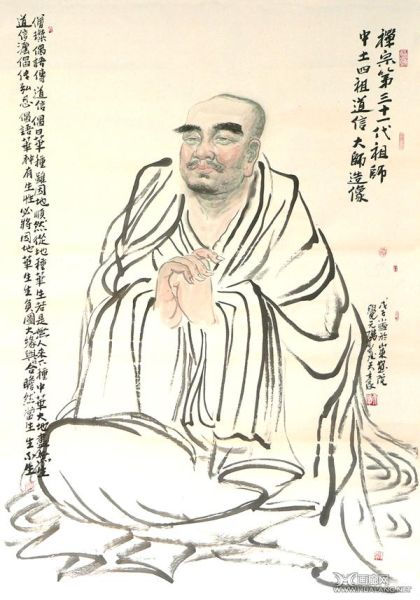
A painting of Dayi Daoxin (580 - 651 CE)
I came across a passage while researching Dayi Daoxin, the fourth "patriarch" of the Zen tradition, and found it interesting, considering that it appears to be a refutation of Daoist metaphysics according to the Buddhist view. I've seen it claimed in a number of places that Zen is some sort of syncretism between Buddhism and Daoism (sometimes written "Taoism"), making it a "Daoist Buddhism" of sorts. One such proponent of this view is the author David Hinton, whose book "China Root" examines terms used in Zen texts by explaining them in their indigenous Chinese context, utilising a number of Daoist terms along the way and claiming that Zen is a more indigenous adaptation of Buddhism.
Here is the passage that started this all:
The great master (Daoxin) said – Zhuangzi taught: Heaven and earth are one finger. All things are one horse. But the Dharmapada sūtra says: ‘One' does not just mean the number one; The intention is the refutation of all numbers. Only students of shallow intellect Mean the number one when they say ‘one'. Thus Zhuangzi seems to be stuck at the idea of ‘one'. Laozi said: So subtle! So profound! Its essence is within. Here, even though there are no categories outside, the mind is still preserved within. The Avataṃsaka sūtra says: Do not be attached to dualistic entities, As there is neither singularity nor duality. And the Vimalakīrti-nirdeśa sūtra corroborates this by saying: Mind does not exist internally or externally, Nor anywhere in between. When we understand this, we can see that Laozi is stuck at the idea of the existence of an essential awareness.
Dayi Daoxin, Sam Van Schaik's "The Spirit of Zen"
As we can see, Daoxin appears to be disputing some of the ideas held by both Laozi and Zhuangzi by pointing out their attachments to certain concepts and uses Buddhist literature to refute this connection. I would like to delve deeper into this, but first we have to understand a bit more about their systems of thought, so I will give a brief presentation and explanation of them in context.
Zen is sometimes likened to Daoism for its non-intellectual, hands-on, witty, non-effortful approach to practice and attaining enlightenment, as well as the portrayal of its masters as wise, riddle-talking old tricksters who tangle their interlocutors in their own conceptual webs. Both traditions emerged in China at different times, with Zen being the later one of the two. Daoism as a philosophy arose in the context of the hundred schools of thought in ancient China, whereas Zen is a school of Buddhism which therefore traces its origins back to the teachings of the Buddha in ancient India.
Some treat Zen like a syncretism of Chinese and Buddhist thought, and the fact that it is a Chinese form of Buddhism makes a relationship to Daoism seems all the more feasible. However, I would argue that viewing Zen as inherently "Daoist" is too simplistic and is in fact a mistaken view, because Zen's doctrinal background is at odds with Daoist metaphysics.
When reading the works of Zen masters, we see that its Buddhist roots are fully on display.
N.B. Please note that this post and its usage of the term "Daoism" does not take into account the religion often called "Daoism", which includes alchemical practices, immortals and an amalgamation of "Chinese folk religion".
What is "Daoism" and who are Laozi and Zhuangzi?

A painting of the mythical figure Laozi

A painting of Zhuang Zhou, commonly known as "Master Zhuang" (Zhuangzi)
Before I start, many people think that Laozi and Zhuangzi belonged to and identified with the same philosophical movement (namely, "Daoism"), or that Laozi was Zhuangzi's teacher, or that the two of them had some sort of relationship or connection to one another. However, as much as they might have in common, they actually do not agree on a number of things, most notably their views on language and metaphysics.
In fact, contrary to popular belief, Zhuangzi may have preceded Laozi. "Daoism" is actually a concept that was invented by scholars in the Han dynasty (202 BCE - 220 CE) trying to categorise earlier thinkers into distinct categories, and "Daoism" became a sort of waste-bin essentially for anything that wasn't clearly Buddhist, Mohist, Legalist or Confucian. The Han scholars inherited a wealth of texts surviving from earlier times which they tried to thematically categorise, including the lone works of Laozi, Zhuangzi, Liezi, Shen Dao and others. Due to the similarity in their writing styles and the concepts they elaborated, scholars thus sorted them into a single school they termed "Daoism" and reinterpreted their works as belonging to a single theory of thought. Neither Laozi or Zhuangzi would've identified as a "Daoist" in their times and would've been perplexed by this categorisation. In fact, as we will see shortly, it's very likely that Laozi did not even really exist, and a better understanding of the context of these texts can better allow us to appreciate their nuances.
Warning: notice how this video assumes that Zen was influenced by Daoism
The texts known as the "Laozi" ("The old master", also called "Dao De Jing", 道德經 "the classic of discerning the path") and "Zhuangzi" ("Master Zhuang") appeared around the time of the Warring States Period (475 - 221 BCE), a time in which the feudal socio-religious framework was crumbling. It had widely been held that there was a "mandate of Heaven (not the Judeo-Christian heaven, but something at this time more analogous to the will of nature)" which accorded a ruler the right to rule, and that the system of feudal relationships down the social pyramid had to be well-maintained in order for society and the natural order of the known universe to function harmoniously. However, the ruling Zhou dynasty was thrown into chaos by a weakening of the ruling state and the rise of opposing regional powers vying for control.
Before long, wars were being fought between various states and the existing social order was thrown into turmoil. War was rampant and unceasing. States ebbed and flowed against one another in a bloody display of technological and bureaucratic innovation in order to supplant rivals. New ideas and theories on the best path or course of conduct in order to structure and organise society began to emerge, in a time known as the "hundred schools of thought". How should the state organise itself? How should people behave themselves? What is the natural way of human beings? This meant an opportunity for new ideas to emerge and proliferate aside from the dominant Zhou social model up to this time. However, certain schools such as the Confucians remained rather conservative and would appeal back to traditional social models.
Most classical Chinese philosophy is centered on the idea of the "dao" (道; "way", "path"), a natural metaphor for human behaviour which describes the best course of ethical action. It is worth noting that despite popular belief, this term does not simply designate a metaphysical "logos" of sorts belonging to the Daoists (after which the school was named, as in "the Dao"), and it was used even by Buddhists. In fact, the Zen patriarch Daoxin's name itself (道信) means "faith in the path". Confucians, Mohists and Legalists alike disputed their varying forms of ethics, trying to regain a form of ethical guidance that would bring society back into harmony. Nature (Heaven) played a very important role in the Chinese worldview, as it was seen to be the commanding force of the universe.
The Chinese understanding of the cosmos was as a fluctuating totality of a psycho-physical substance called "qi" (氣) which makes up all matter and all forces within the cosmos. Chinese philosophy is naturalistic, and so it was therefore important to find a way to live alongside nature rather than against it. Two such ways of viewing this sense of harmony with the world were the ones taken by Laozi and Zhuangzi.

A map of the various states existing during the Zhou and the philosophers born in them, sorted according to the later Han-dynasty classification
What did Laozi and Zhuangzi write about?

Before introducing Laozi, it is probably worth mentioning that he is thought to be a mythical figure and probably never existed. In the Zhuangzi, there appears a figure called "Lao An" who was portrayed as Confucius' teacher, who we now think might have been the inspiration for Laozi.
The Dao De Jing was probably written by a number of anonymous scholars who purposefully wrote the document in an older writing style similar to the kind of language used in the ancient classics in order to give it an air of antiquity and seniority (as Chinese culture regards what's older as being wiser and more orthodox, not dissimilar to the same notion spread by the Stoics in Europe). So as a result, the figure of "the old master", or Master Lao - Laozi ("zi" meaning something like "master" in that day) - was probably made up, the Dao De Jing was probably written much later than was originally thought, and the true authors were probably young scholars simply reacting to the competing Confucian and Mohist ideas of their time, which claimed to have found "the way", or an ethical path grounded in natural order which humans ought to follow (道 dao).
These authors appear to have refuted the arbitrary moral proclamations made by their philosophical rivals by arguing that nature does not have one set preference for one way or another, and further argued that language obscures the reality of things (the Confucians and Mohists believed language to be key in refining morality), and so we must abandon 'knowing' and live in a state of 'wu wei' (無為, "not-deeming") where we do not let language and concepts obscure our view of reality. This was completely counter to the form of mortality taught by the Confucians and Mohists.
The Dao De Jing states that words create their opposites, are all relative to one another and are pushed onto us by society's desires, which obscure our own desires. As such, we do not live freely until we abandon these ideas and live more spontaneously, with a mind like an uncarved block. Instead of teaching social acculturation and moral cultivation like the Confucians, Laozi taught de-cultivation and the return to an anterior, more natural form of being.
The five colors blind the eyes; the five musical tones deafen the ears; the five flavors dull the taste. Racing and hunting madden the mind.
Dao De Jing, chapter 12
The reason that language was taken as an obstacle to understanding the true way is that, in Chinese epistemology, "knowing" is related to language in the sense that the attribution of a name to a thing defines the roles that should come around it and guides behaviour in a way that one could say they "know" what a thing is because of how they interact with it. In the Dao De Jing, relativism and the transcendence of opposites is a common theme. One of the things the authors were trying to get at is that no one path - or dao - is the eternal and single natural dao, unlike what the Confucians and Mohists were proclaiming. Long is decided by short just as short is decided by long. The authors appeared to express a certain skepticism regarding language and social conventions and how they format people's behaviour to see things in such a dualistic way.
As a result, "wu wei" (無為, "not-deeming") is presented as an ideal which transcends language and sees the world for its spontaneous and mystical appearance. For the reader's benefit, wu wei is often seen as some sort of "non-doing" or "spontaneous action" concept analogous to the flow-state discussed by the Hungarian-American psychologist Mihaly Csikszentmihalyi. I'm not exactly sure what the basis of this is, but it likely comes down to the multiple understandings of the term 為, which can mean "to do", "to be", "to act as", "to take something as" and more.
The concept of "wu wei" was first hinted at in Conficius' "Analects", in the following passage:
The Master said, 'Was it not Shun who did nothing and yet ruled well? What did he do? He merely corrected his person and took his proper position as ruler'
Analects, chapter 15
The term here is showing that the ruler Shun did not need to exert effort in order to align himself with the Confucian virtues; he has embodied them already and manifests them without effort.
However, if the Confucians saw their ideal as becoming like finely carved jade, Laozi's was to revert to being uncarved wood - to retaining a more primary natural state before all secondary learning and shaping. For this reason, I would personally follow in the thought of Professor Chad Hansen of the University of Hong Kong and translate this term more as "not-deeming".
The notion of engaging with the world more naturally and spontaneously without additional social contrivances is also perhaps where the "non-doing" idea comes from. It could also be noted that Daoism later became associated with longevity practices through "inner alchemy" (neidan shu 內丹術) and that the idea of moving and behaving in accordance with "the great Dao" (the flux of nature itself) was thought to be a source of immortality. In this context, wu wei could have taken on a more "flow"-like definition.
When your body is not aligned,
The inner power will not come.
When you are not tranquil within,
Your mind will not be well ordered.
Align your body, assist the inner power,
Then it will gradually come on its own.
A passage from the inner alchemy classic, the Guanzi (管子)

A Japanese painting of the Daoist immortal (仙) Liu Haichan, a master of inner alchemy, accompanied by a three-legged toad, a symbol of wealth and good fortune
Regarding Laozi's position, it was noted by Mohists - who were champions of reasoning and language - that Laozi's was a paradoxical stance, because using language to tell people not to trust language comes down to the same paradox as saying: "This sentence is false". How can you tell people to be skeptical of language via language? A more mature expression of Daoism would come in the form of Zhuangzi's philosophy.
Zhuangzi was a lot more complex than Laozi. He saw language and knowing(s) as little more than the course of nature itself, so no one path or dao could root itself in a natural authority as a claim of legitimacy. Everyone is on their own path in an ocean of paths (both natural and artificial/human - Zhuangzi didn't see the difference), and so language and knowing can't be seen as being artificial or non-natural, as Laozi saw them. In this sense, Zhuangzi isn't telling people to abandon knowledge, but he did say that change is constant, and that we are all embarked on our ways through time, and that as such our concepts and knowings should adapt and follow us throughout time accordingly. He was a relativist and thought that our ideas of the world should change along with it and never stick to any absolute.
The fish trap exists because of the fish. Once you've gotten the fish you can forget the trap. The rabbit snare exists because of the rabbit. Once you've gotten the rabbit, you can forget the snare. Words exist because of meaning. Once you've gotten the meaning, you can forget the words. Where can I find a man who has forgotten words so I can talk with him?
Zhuangzi
Behind all of this epistemological discussion is a difference in metaphysics. What both philosophers are most remembered for is their system of metaphysics - "the Dao", or the great dao, the way in which the world flows. However, they don't both approach the Dao in the same way. Laozi is known for his conception of a Dao of cyclical opposites, where non-existence is the source of existence and things revert to their opposites in a sort of dance of duality. This is a philosophy of "becoming" rather than one of "being", where things are regarded more are processes than as concrete, permanent things in themselves. This also underpins Laozi's system of epistemology, where reverting to a more primitive, primordial state of being would being balance back to the world.
Similarly, Zhuangzi sees the world as being in a constant flux of change which the skilful and wise know how to best manoeuvre, and where the best course of action is perpetually changing according to circumstances. In a sea of individual paths, criss-crossing and colliding with one another, we must know how best to navigate and trace our own path. Everything changes, nothing is absolute. However, unlike Laozi, Zhuangzi's "Dao" is not one of cylical ebb and flow, to-and-fro, but one where things are in constant transformation, as they rise out of and dissolve into the same sea of change that all things are a part of.

The arrival of Buddhism and Mahāyāna philosophy

A statue of the great Chinese monk Xuanzang (602 - 554 CE) who travelled to India in search of original Indian Buddhist texts to bring back to China, kept in the Giant Wild Goose Pagoda pictured behind him; he was the inspiration to the protagonist monk in the Chinese epic "Journey to the West"
When Buddhism first arrived in China during the Han dynasty (202 BCE - 220 CE), scholars attempted to understand this new, foreign religion. The Chinese, attempting to translate incoming texts, referred to indigenous philosophies in order to make sense of it, and concluded that Buddhism was some form of foreign Daoism. The Buddhist term "emptiness" (Sanskrit: शून्यता; śūnyatā) - the term used by Mahāyāna Buddhists to describe the quality of things being empty of any independent, self-defining essence (unable to exist independently or dependently from anything else in a state between existence and non-existence) - was likened to Daoism's primordial "non-existence" (無) from which all thing emerge, and Bodhisattvas (highly-realised spiritual beings aspiring for enlightenment in this world and other celestial realms) were seen as Buddhist forms of the "immortals" (highly-realised spiritual beings in accordance with the natural flow, granting them everlasting life in this world and other celestial realms). However, this was all unravelled with the arrival of Indian translators, who set the record straight. Emptiness now became translated as 空, a conceptually distinct term which will become the central issue distinguishing Zen and Daoism.

A shrine devoted to Guanyin, the Chinese version of the bodhisattva of compassion Avalokitesvara
Buddhism is concerned with the nature of human suffering and dissatisfaction. It takes a deep look at the human condition and makes the prognosis that we are fundamentally dissatisfied beings, and that this is the source of our woes and anguish. Caught in a stream of fleeting phenomena we cannot permanently hold onto or control, we soon find ourselves dissatisfied somehow. When we get what we want, we rejoice and then lose the thrill. When we don't get what we want, we experience envy, injustice, and craving. What's more, we try to avoid the inherent impermanence of things by clinging to things as if they won't eventually change, denying our own mortality in the process. Once we've gotten a hold of something that makes us happy, we dig in our heels and refuse to let go, and blame the world for being unfair when the problem is our own view of things.
We might find ourselves feeling satisfied in our lives at some points, but sooner or later we most often find ourselves back on the hedonic treadmill, chasing the next thrill or pleasure, caught between one thing and the next. Hungry one second, full the next, only to find ourselves hungry again and craving more. Rather, dissatisfaction is our obstacle to lasting happiness, and it is this that we must overcome and deal with if we are to lead a more fulfilling life. Worse yet, according to the traditional Indian worldview, we are doomed to repeat this cycle indefinitely, as our past thoughts and behaviours will carry on to the next life and see us reborn according to these habits
Early Buddhism is about going beyond this vicious cycle - called samsāra, the cycle of life and death - and finding a truer, more lasting sense of peace - called nirvāna, awakening or enlightenment (although the true meaning of this word is "extinction", as in the extinction of desires). This is achieved through a cognitive-behavioural methodology known as the Noble Eightfold Path, which aims to establish a wise and truthful relational outlook on the world coupled with ethical, selfless action through mental and behavioural training. This leads one to a 'true' vision of the world in its total interrelationality which cuts off the unrealistic and irrational desires at the base of our suffering. In othe words, we learn to live with things as they are instead of as we wish them to be. Later Buddhism (Mahāyāna) is concerned with remaining within the cycle of samsāra in order to help all beings realise the teachings of the Buddha.
Enlightenment is synonymous with "Buddhahood" - becoming a Buddha (awakened one), as if waking up from the dream of transient, ordinary experience and seeing things for what they are. The term "Buddha" is thought to also have a common root with the term "to bud" or "to blossom" in Sanskrit - an ancient classical language of South Asia, which also adds a certain aesthetic component to the term.
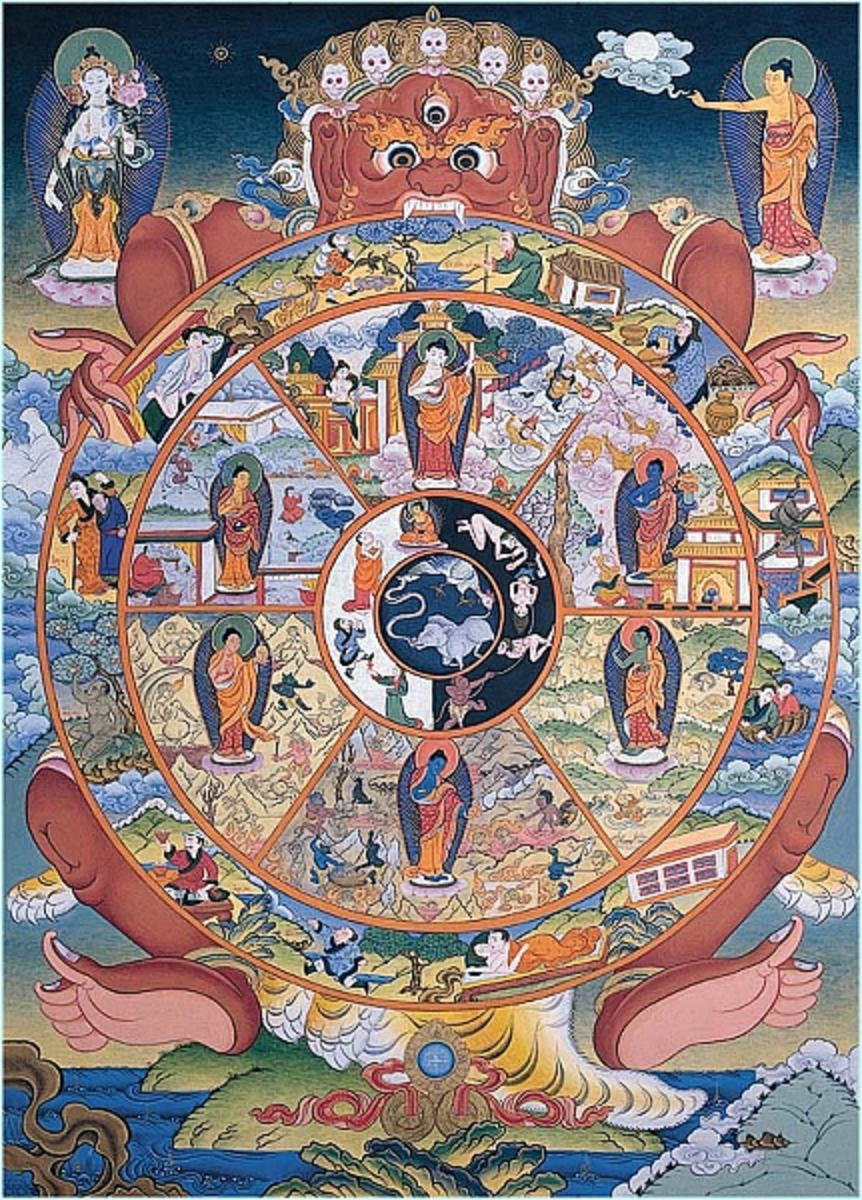
A visual representation of the six realms of existence which beings move through in samsara in the jaws of Mara - the demonic representation of ignorance (Sanskrit: अविद्या; "avidya"), to be understood either as literal metaphysical realms or as states of mind.
In the 5th century CE, South Asian society was dominated by a strongly collectivistic socio-religious framework in which people's roles in society were prescribed according to their age, profession and social caste, headed by a priestly caste which would keep the social order intact through sacrificial rituals. In this society, the concept of a soul or essence, similar to the Judeo-Christian tradition (although the latter does not believe in reincarnation), can also be seen in the form of the Vedist "ātmán" (which means "breath", "life" or "soul", just as the word "anima" does in Latin). This ātmán travels from body to body in the cycle of life and death (samsara) depending on past deeds.
At this point in South Asian history, due to agricultural surplus and a thriving economy, a merchant class was growing rapidly which shook the prevailing caste system. Many dropped out of the social system and became ascetic renunciants. Increasingly, the primary spiritual goal became seeking one's own individual deliverance from the cycle of life and death (samsāra). Siddhartha Gautama - the mythical name given to the figure sometimes known as "Shakyamuni Buddha" (the awakened one of the Shakya tribe) - is said to have been one of these seekers and embarked on a journey which led to his own enlightenment.
Buddhism emerged and became a heterodox school of thought which challenged prevailing ideas and norms. For example, people of all castes were welcomed into the monastic community (sangha) and were treated equally. Eventually, women - who were seen as secondary to men in traditional society - were welcomed too. The acceptance of lower-caste people and women meant that groups traditionally disenfranchised by Vedist society were given a place they could go as a refuge and seek meaning. In fact, the Buddha rejected the authority of the Vedic sacred texts which were at the heart of South Asian society then. This goes to show that Buddhism took a divergent approach to understanding not only the mind but the human condition as a whole from its contemporaries.
If the interrelated cosmos were seen as an expansive net, Vedism could be said to be more focused on the individual nodes or souls, whereas Buddhism was more focused on the connections which undermine the independent existence of said nodes. Buddhist inner scientists looked within with the use of meditative practices to find that nothing can reliably be pointed to as the "self", whether it's the mind, body, emotions or consciousness. This teaching of "anātman" (non-self) was explained by the fact that the individual can be examined to be made up of many different constituent aggregates, which are caught in a chain of causality and dependent origination which means that they are constantly in flux. Buddhism teaches that everything is impermanent and that we cannot reliably grasp onto anything permanently.
With this, Buddhists set out to understand this lack of self. Exhaustive lists were drawn up by schools such as the Abhidharmika school as to the various things that can and do exist, and the prevailing view became one of reality being constituted of various fundamental building blocks and experience having real, external objects grounded in an externally real environment. This led to a strong counter from various figures and movements which all became known as the Mahāyāna (Great Vehicle) movement. Among those in this movement, the brilliant philosopher Nagārjuna developed the teaching of non-self and dependent origination and came to the conclusion that nothing can exist fully dependently or independently from everything else, discovering a "Middle way" (Madhyāmaka) between these two ontological extremes which he believed to be the Buddha's true teaching.

A painting of Nagārjuna
Nagārjuna would make his points by a series of aphatic (negative) clauses and reductio ad absurdum arguments called "prasanga" (Sanskrit: प्रसङ्ग), demonstrating how ridiculous any four points of something existing, not existing, both existing and not existing or neither existing nor not existing would be. This would be called Nagārjuna's tetralemma, and it showed how in fact everything in the world is "empty" (śunyā) of its own independent essence, meaning it does not in fact exist as we perceive it. As such, our views of the world and how we use language to designate phenomena are merely conventional. There is a conventional view of the world as we know and see it, and another absolute view of the world characterised by emptiness.
Neither from itself nor from another, Nor from both, Nor without a cause, Does anything whatever, anywhere arise.
Nagārjuna's "Mūlamadhyamakakārikā"
This relativistic argumentation and idea that reality is beyond all viewpoints and extremes might seem reminiscent of Zhuangzi, and the reduction of language to little more than just social convention to Laozi, but we will see how they are actually quite different.
Another influential movement known as Yogācāra (yoga practice) emerged, so-called because its practitioners used meditation practice as their primary tool for observing reality. They posited that the mind is primordial in human experience, and that everything occurs within the mind itself, so there is no need to explain the world in terms of external phenomena. Experience underlies every perceivably external phenomenon we can engage with. What's more, the mind underlies everything, and so external objects do not in fact exist in reality as we perceive them to. As such, the Yogācāra approach was more phenomenological. They examined the workings of the mind and came up with a cataphatic model of understanding it, affirming positive statements about the structure of the mind and how it exists.
Everything conceived as self or other occurs in the transformation of consciousness.
Vasubandhu's "Thirty Verses on Consciousness Only"
This combined movement had a profound effect on Buddhism going forwards, and although there would be disputes between Madhyamaka and Yogācāra theory going forwards (especially in later Indian Mahāyāna Buddhim and Tibean Buddhism), the concept of emptiness occuring both analytically and as a matter of phenomenological observation reshaped Buddhism forever.
Emptiness became synonymous with the intrinsic nature of reality itself, and the question of where a Buddha goes after death led to the theory that they would become transcendently unified with the deepest nature of reality itself. This idea combined with the teaching on the two views of reality (conventional and absolute) and elaborated into a theory of the three Buddha-bodies: the truth-body (dharmakāya; the deepest level of reality), the bliss-body (sambhogākāya; an intermediary subtle body) and the emanation-body (nirmanākāya; the world of appearances). The three bodies are not three different bodies but three aspects of the same reality; as such, a Buddha simply realises their true nature - the deepest form of reality - while also existing as the other two, as a manifested physical being. It was also theorised by the "Pure-land" schools that a Buddha creates their own Buddhaverse (effectively their own universe) as they become inherently synonymous with reality itself, and that each universe has a Buddha as its creator.
This also later combined with a theory called Buddha-nature theory (tathāgathagārbha), which posits that the potential to become a Buddaha lies dormant in worthy beings, and expanded to mean that all beings are inherently capable of Buddhahood, as their fundamental nature is no different from that of a Buddha and is none other than the Buddha-body of reality (the truth-body) itself.
This effectively raised emptiness to the central teaching of all of Mahayana Buddhism, and undercut all of the dualistic cultivation of the earlier Buddhist schools with an instantaneous, spontaneous insight into the Buddha-mind which would have a profound influence on Zen.
Form is no other than emptiness, Emptiness no other than form. Form is only emptiness, Emptiness only form. Feeling, thought, and choice, Consciousness itself, Are the same as this. All things are by nature void They are not born or destroyed Nor are they stained or pure Nor do they wax or wane So, in emptiness, no form, No feeling, thought, or choice, Nor is there consciousness. No eye, ear, nose, tongue, body, mind; No colour, sound, smell, taste, touch, Or what the mind takes hold of, Nor even act of sensing. No ignorance or end of it, Nor all that comes of ignorance; No withering, no death, No end of them. Nor is there pain, or cause of pain, Or cease in pain, or noble path To lead from pain; Not even wisdom to attain! Attainment too is emptiness. So know that the Bodhisattva Holding to nothing whatever, But dwelling in Prajna wisdom, Is freed of delusive hindrance, Rid of the fear bred by it, And reaches clearest Nirvana
The Heart Sutra

The spread of Buddhism from its birthplace to other lands across Asia
The Zen movement

The Chan (禪) movement of Buddhism is one that arose out of Tang-dynasty China (618 - 907 CE) from earlier meditative schools to become the most popular and patronised school of Buddhism in the country by the Song dynasty (960 - 1279 CE), spreading then to Korea, Vietnam and Japan along with the wider spread of Chinese culture across the continent, forming new schools now known under local renditions or readings of the Chinese character 禪 ("Seon", "Thien" and "Zen", respectively), itself a shortened form of the term "Channa" (禪那), which is a Chinese rendition of the Sanskrit term "dhyana", commonly and misleadingly referred to in English simply as "meditation". The reason this term is misleading is that it can mean many different things but is often taken to simply refer to seated meditation practice. I have seen many a debate focused on the role of seated meditation (座禪; Chinese: zuochan, Japanese: zazen) in Zen practice, which has probably waxed and waned in its centrality to the tradition over the long history of Zen. I will avoid this by simply quoting the definition of zazen in The Platform Sutra (translated by Red Pine), allegedly delivered by Huineng (638 - 713 CE; the post-humous Sixth Patriarch of Zen), although it was probably heavily redacted by later editors:
By 'practising' (座, "sitting"), this school of ours means not being obstructed by anything and not giving rise to ideas about external objective states. And by 'Zen' (禅), we mean seeing your true nature without being confused.
[...]
Externally, to be free from appearances is 'Zen' (禅). Internally, not to be confused is 'meditation' (定, "fixity", "samadhi").
The Platform Sutra
As we can see, the notion of not giving rise to ideas about external objective states is reminiscent of Nagārjuna and the Yogācāra view that reality as we see it is simply an illusion of the mind, meaning that giving rise to ideas about it is making ourselves susceptible to mental trappings and attachments which cause us suffering. This could be compared to Laozi's view on language, except it still retains a firmly Buddhist soteriological context.
This description of Zen supposedly given by Huineng is thought to actually be either a writing of his supposed student Shenhui, who formed the Heze School and proselytised the rural "Southern School" of Zen, or of the Niutou "Oxhead" School of Zen, which reconciled differences between the spontaneous-enlightenment "Southern School" and the urban, gradualist "Northern" or "East Mountain" School of Zen. The myth of the Southern and Northern schools is one many students of Zen are familiar with, and exemplified one of the biggest doctrinal disputes of the time: namely, whether enlightenment is something that's immanent and underlies our everyday experience or if it's something that's gradually built towards with practice. It's been determined by academics that this is simply a mythical, propagandised account and that both the "Northern" and "Southern" schools were actually both gradual and spontaneous in their practices. However, we will indulge in the legend a little bit in order to show how Zen presents itself.
The most important thing to note is the Mahāyāna view of enlightenment. Early Buddhism saw practice as a means of cultivation for reaching enlightenment (nirvāna) for oneself, making one an arahant. Mahāyāna takes a more non-dual approach to enlightenment for the sake of all beings and argues that if enlightenment is an absolute state, it can't be something that can be reached or built towards through practice, because that makes it a relative state that can just as easily be left. Instead, enlightenment must be something hidden in plain sight - samsāra and nirvāna are not two different things, and we must aid all beings in their quest to realise this, remaining a bodhisattva (one who aspires for enlightenment).
This non-dual approach is the basis of both the Southern and Northern Schools of Zen. The real dispute here isn't one of immanent or far-off enlightenment but one of non-duality and the realisation of emptiness, which is best exemplified by two mythical poems from the Platform Sutra written by Shenxiu (606 - 706 CE; the purported heir to the 5th Patriarch of Zen, who founded the Northern School) and Huineng:
Body is the bodhi tree
Mind is like clear mirror stand
Strive to clean it constantly
Do not let the dust motes land
Shenxiu, The Platform Sutra
Bodhi really has no tree
Nor is clear mirror the stand
Nothing’s there initially
So where can the dust motes land?
Huineng, The Platform Sutra
The 5th Patriarch chose Huineng as his successor. The reason for this as explained in this myth is that Shenxiu makes the mistake of "mirror-wiping". He sees the fundamental awareness of Buddha-mind as a mirror that has to be polished in order to uncovered, but this makes the mistake of creating a duality between the observer and the observed and making Buddha-mind a reified 'thing', a fundamental self not much different from an atman, whereas the nature of mind is emptiness itself.
The essence of Zen practice is seeing your "true nature" (Buddha-nature), which means understanding the nature of mind and realising Buddha-mind. Zen is said to be "outside the written word" and does not rely on conceptual learning, which they argue can be an obstacle to enlightenment. This isn't something beyond us, but something already within us. We are never apart from our Buddha-nature, we simply don't realise it. In other words, we are already dormant Buddhas, we just fail to realise it. This is because our true nature is characterised by emptiness, and the mind itself is emptiness; therefore, it has never been apart from the truth of the universe, which was characterised by the Buddha-mind itself. You can see how the Mahāyāna philosophy discussed earlier is evident here.
Master Huangbo Xiyun (d. 850; whose sermon below I have done a separate meta-translation of) explains:
The Buddhas (beings who have transcended the cycle of birth-and-death, awakened or enlightened ones) and all sentient beings (beings that originated from the aggregation of causes and conditions and who continuously experience the cycle of birth-and-death) are only of one-mind; there is no other dharma. This mind, since beginningless time, has never been born and never been annihilated. It is not green and not yellow, has no form and no characteristic, doesn't belong to existence or non-existence. It cannot be considered new or old, is neither long nor short, is neither big nor small.
Transcending all limited measurements, names, traces, comparisons - the present basis is it; activating thought is deviation. Just like the empty sky that is without boundary, it cannot be estimated or inferred. Only this one-mind is the Buddha. There is no difference at all for Buddhas or for sentient beings.
Yet sentient beings, attached to characteristics, seek outwardly [for this mind]. Seeking [it] turns into missing [it]. Employing Buddha to find Buddha, using mind to apprehend mind, even till the exhaustion of this kalpa (aeon, the period of time spanning the formation of a world/universe through to its destruction), even till the end of this lifeform, still, there can be no attainment. For [the seeker] does not know that, in resting thought and forgetting concern, Buddha manifests by itself.
Huangbo Xiyun, The Transmission of Mind
In short, there is no essential difference between Buddhas and other sentient beings as they all share the same fundamental awareness. However, what makes a Buddha a Buddha is their recognition of their true nature, the open and unlimited awareness (mind) in which all phenomena manifest. Other sentient beings are caught in chasing the manifestations of their minds in the cycle of life and death (samsara). As such, seated meditation is not the essence of Zen practice, but meditation - as in the recognition of our true nature no matter the circumstances - is.
The later Japanese Zen Master Bankei Yōtaku (1622 - 1693) echoed the same sentiment in his own sermons, showing how the realisation of Zen practice is abiding in emptiness - the unborn:
As for zazen, since 'za' (座, "sitting") is the Buddha Mind's sitting at ease, while 'zen' is another name for Buddha Mind, the Buddha Mind's sitting at ease is what's meant by zazen. So when you're abiding in the Unborn [Mind], all the time is zazen; zazen isn't just the time when you're practicing formal meditation. Even when you're sitting in meditation, if there's something you've got to do, it's quite all right to get up and leave. So in my group, everyone is free to do as he likes. Just always abide at ease in the Buddha Mind.
Bankei Yōtaku
Being a school of Chinese Mahāyāna Buddhism, Zen is strongly influenced by early-Mahāyāna Mādhyamaka and Yogācāra philosophy, inheriting from the Indian Kumarajiva and Vasubandhu most notably. Although these two movements have debated and competed in Indian and Tibetan Buddhism, Chinese Buddhism did not inherit as much of this and syncretised them its own way.
Having discussed this school after an in-depth explanation of Daoism and Mahayana Buddhist philosophy, we can compare it to Daoism and explain in what ways the two might seem similar but are at odds with one another.
Emptiness vs. Dao: Zen and Daoism are not the same
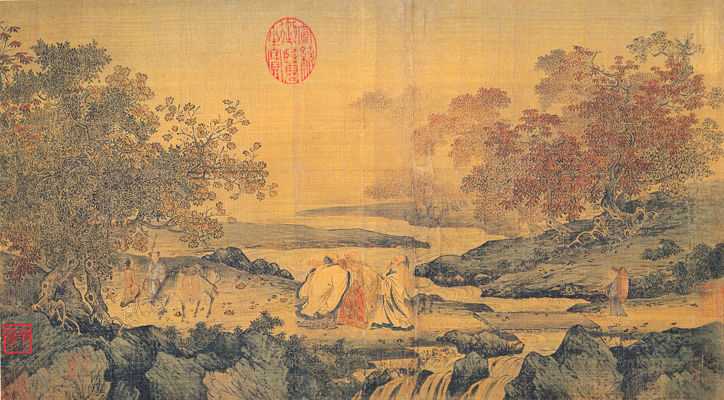
The Buddha, Confucius and Laozi dancing
In the beginning, we looked at how Laozi and Zhuangzi are concerned with mankind's accordance with the phenomena of the world; this is because their philosophies are physical naturalisms which view the world in terms of the fluctuation of a psycho-material substance called "qi". As such, people ought to position themselves relative to this flux (whether cyclical or ever-evolving) in order to find the best outcomes for themselves. This is not very dissimilar from Buddhism in that the Buddha taught that ignorance of the nature of reality was the source of our suffering. In fact, we might be able to draw comparisons between this qi-focused cosmology and the attempts of the Abhidharmika schools to explain the world in terms of a number of primary building blocks. However, this does not stand in line with the Mahayana Buddhist view of reality.
Mahāyāna philosophy - following in the footsteps of Nagārjuna - sees it as impossible for us to determine the ground or fundamental basis of reality, because everything is dependent on prior causes and conditions. As such, how could we arrive at a fundamental, causeless ground or substance constituting all of reality? However, to explain things only in terms of prior causes and conditions is equally as absurd as to take things as existing independently from causes and conditions. If things are caused by their prior conditions, why do we then see things as existing in and of themselves? What's more, Buddhism places emphasis on the fact that our minds define our realities more than matter or any other constituent does. How then can we take reality to be a monistic flux of substantial psycho-physical matter if this is just a perception of the mind itself?
This fundamental difference hasn't stopped people seeing the similarities between Zen Buddhism and Daoism, with many even believing Zen to be promoting a similar system of teaching and metaphysics to Daoism due to its non-scriptural, mystical and experiential basis. You can see how Laozi's views on language are very much respected by some in the contemporary Zen community, especially with regards to having a "beginner's mind" which is untainted by prior concepts. I've seen many similar allusions to Zhuangzi among Zen enthusiasts too, and both philosophers appear to be well respected figures in the community.
But a further examination of how Zen masters talk about Daoism will reveal more to us about their relationship to it. Let us take the following quote as further evidence of this point, as the Zen master Nanquan Puyuan (c. 749 - 835 CE) discusses Daoist teachings with an officer:
As the officer Lu Hsuan was talking with Nan Ch'uan, he said, "Master of the Teachings Chao said, 'Heaven, earth, and I have the same root; myriad things and I are one body.' This is quite marvelous. '' Nan Ch'uan pointed to a flower in the garden. He called to the officer and said, "People these days see this flower as a dream."
Blue Cliff Record, case #40
Nanquan appears to be making a similar criticism as Daoxin about the idea of "oneness". Buddhism does accept a truth-body of reality which represents the deepest level of reality but this is not a singularity or oneness. The idea of a oneness creates a duality between oneness and multiplicity which cannot be abided by in Mahayana philosophy. Instead, there is a Middle Way between these two extremes which Buddhism walks.
Let us also take this example of Zhaozhou Congshen (778 - 897 CE; known in Japanese as "Jōshū"):
A monk asked, "Without pointing at any particular doctrine, Master, what is your teaching?" Joshu said, "I do not preach the teaching of Bozan [a center of Taoist sects]." The monk asked, "If you do not preach the teaching of Bozan, what, then, is your teaching?" Joshu said, "I have told you already that I do not preach the teaching of Bozan." The monk said, "So that's what it [your Zen] is, isn't it?" Joshu said, "So far I have never showed it to the people."
The Sayings of Joshu #176
Here, Zhaozhou very wittily distances himself from Daoism all while delivering a Zen teaching. The monk does not realise that Zhaozhou is answering his question quite pertinently, explaining phenomena such as they are.
As such, Daoism and Buddhism actually do not study phenomena in the same way. One is focused on the psycho-material flux of a naturally-ordered cosmos and finding oneself within this flux, while the other is focused on the nature of suffering and discovering the true nature of self and reality, beyond mind and matter.

A Japanese painting of Nanquan Puyuan holding a cat in a depiction of the famous fourteenth case of the "Gateless Barrier" named "Nanquan kills the cat"
At times, Zen might appear to have some borrowings from Daoism. The term "wu wei" has in fact been used in Zen texts, such as in Huangbo's "Transmission of Mind" text quoted above.
If you now set about using your minds to seek Mind listening to the teaching of others, and hoping to reach the goal through mere learning, when will you ever succeed? Some of the ancients had sharp minds; they no sooner heard the Doctrine proclaimed than they hastened to discard all learning. So they were called 'Sages who, abandoning learning, have come to rest in spontaneity (wu wei)'.
Huangbo Xiyun, The Transmsission of Mind
Harkening back to earlier, I think that "non-deeming" is a more fitting definition of this term in the Zen sense of its use, as it corresponds with the overcoming of dualities presented in the Vimalakirti, Diamond and Lankavatara Sutras which Zen masters often reference. However, terms used by Zen masters such as 無念 (wunian; no-conceptual-mind) and 無心 (wuxin; no-mind) were already being used at this time in Zen texts which pretty much mean the same thing, so why refer to wu wei? It could be that this is speaking of a cultivation and embodiment of the Buddha-mind similar to the original meaning of wu wei as the Confucians meant it with regards to Shun embodying Confucian values, earlier.
Another example is the borrowing of a meditation practice - "guarding the one" (shouyi; 守一)- which was an alchemical Daoist single-pointed concentration practice. However, was the practice itself a Daoist borrowing, or did Zen masters simply borrow the name for one of their practices? Buddhism boasted a wealth of meditative techniques at this stage, from simply follow the emerging "tantric" practices at the time of early Zen, which makes use of imagery and movement to summon elements of the subconscious mind in order to catapult the individual towards enlightenment.
Furthermore, there are stylistic choices in terms of how Zen masters and their anecdotes are presented in classical Song-dynasty Zen literature, which is quite reminiscent of the Zhuangzi. The use of witty and paradoxical language as well as twisting conventions and eccentric character quirks makes for a thoroughly delightful and entertaining read in either case, Zhuangzi or Zen anecdote. However, this stylistic different might be attributed to the rise in Neo-Confucianism at the time, which put a pressure on Buddhism (and particularly Zen, which had risen to become to most popular Buddhist school in China) and Daoism to distinguish themselves in order to garner patronage and new initiates.
Whether there was indeed a stylistic borrowing from Daoism to Zen or not is hard to say, and it's at this point that we must also be aware of the fact that Zen emerged in a new cultural context to its Indian forebears. In China, Confucian and Daoist terminology and ideas had already had centuries to become part of the conceptual web of Chinese culture. Certain phrases, terms and memes would have become common and in fact been divorced from their original contexts, in a way that's not too dissimilar from how Judeo-Christian terms have become an ordinary part of language in English, with phrases such as "What a blessing/godsend!" or - on the more profane side - "Jesus Christ!" being phrases even atheists can be caught uttering. As such, we must as ourselves whether the imputed borrowing of Daoist ideas and terminology is legitimate or merely incidental. East Asia has long been a syncretic cultural sphere where Confucianism, Daoism and Buddhism - although they have been at odds - have also blended and become non-exclusive to one another for the many people whose lives they affect.
Regarding this Zen Doctrine of ours, since it was first transmitted, it has never taught that men should seek for learning or form concepts. 'Studying the Way' is just a figure of speech. It is a method of arousing people's interest in the early stages of their development. In fact, the Way is not something which can be studied. Study leads to the retention of concepts and so the Way is entirely misunderstood. Moreover, the Way is not something specially existing; it is called the Mahayana Mind - Mind which is not to be found inside, outside or in the middle. Truly it is not located anywhere. The first step is to refrain from knowledge-based concepts. This implies that if you were to follow the empirical method to the utmost limit, on reaching that limit you would still be unable to locate Mind. The way is spiritual Truth and was originally without name or title. It was only because people ignorantly sought for it empirically that the Buddhas appeared and taught them to eradicate this method of approach. Fearing that nobody would understand, they selected the name 'Way'. You must not allow this name to lead you into forming a mental concept of a road. So it is said 'When the fish is caught we pay no more attention to the trap.'
Huangbo Xiyun, The Transmsission of Mind
The translator of the previous passage notes that it has a particularly Daoist flavour, and this is evident to us in the Laozi-an view of language and learning. Huangbo also appears to be quoting the Zhuangzi quote from earlier. When I first came across this passage, I thought that it - along with the other quoting "wu wei" - was evidence of a Daoist influence on Huangbo's ideas and terminology. However, it is evident from the rest of the text that this is not so:
From the earliest times the Sages [Taoist] have taught that a minimum of activity is the gateway of their Dharma; so let NO activity be the gateway of my Dharma! Such is the Gateway of the One Mind, but all who reach this gate fear to enter. I do NOT teach a doctrine of extinction! Few understand this, but those who do understand are the only ones to become Buddhas. Treasure this gem!
Huangbo Xiyun, The Transmsission of Mind
Here, we can see how Huangbo utilises the teaching of emptiness to outdo the Daoists, with an expression that is similar to the Heart or Diamond Sutras. If emptiness is the truth of reality, then there is no practitioner; there is no practice; there is nothing practised; there is nothing attained. If the Daoists taught a minimum of activity in order to not add contrivance to the Dao, Huangbo teaches no activity and the realisation of what this means.
Coming back to the original passage from the beginning, it appears to come after an except where Daoxin gives instruction to his disciples on how to die. The translator, Sam Van Schaik's commentary on the original passage is as follows:
The instructions on dying for meditators conclude Daoxin’s meditation teachings in this chapter. They are followed by some comments on Daoist texts. Daoxin does occasionally borrow phrases from Daoist literature, and seems to have been especially fond of the Zhuangzi, a book of teachings attributed to the sage of the same name, who lived in the third century BC. The Zhuangzi is a complex text, probably formed over centuries. It is difficult to sum up, but many chapters (including the one quoted here by Daoxin) present us with arguments suggesting that our concepts and judgements are merely conventions, relative and not absolute. At times, the Zhuangzi sounds very like a Zen teaching. Perhaps the greatest difference is that in Zhuangzi the ultimate truth is oneness, whereas for many Zen teachers, the ultimate truth is emptiness. It is this idea of oneness that Daoxin criticizes here, quoting the cryptic lines: Heaven and earth are one finger. All things are one horse. Here is the full passage from the Zhuangzi: To use this finger to show how a finger is not a finger is no match for using not-this finger to show how a finger is not a finger. To use this horse to show that a horse is not a horse is no match for using not-this- horse to show that a horse is not a horse. Heaven and earth are one finger. All things are one horse. This doesn’t help much, but the following passage makes it clearer: Something is affirmative because someone affirms it. Something is negative because someone negates it. Courses are formed by someone walking them. Things are so by being called so. In other words, our logic is merely conventional; even the linguistic distinctions between a horse and what is not a horse only apply because we apply them. Ultimately horse and not-horse depend on each other and are one and the same thing. Daoxin then quotes from a Buddhist sutra to show the limitations of Zhuangzi, picking up on the idea of oneness: ‘One’ does not just mean the number one; It implies a refutation of phenomena being many. To be honest, it is hard to see how this passage can be used to criticize the Zhuangzi; the oneness of the Zhuangzi is very much ‘a refutation of phenomena being many’. Nevertheless, Daoxin’s criticism that Zhuangzi gets ‘stuck’ at the idea of oneness does have a point, as his text does not deconstruct the concept of oneness itself, which a Buddhist would. Daoxin then turns to the Daodejing, the early Daoist classic attributed to the sage Laozi, which needs no introduction here. Daoxin quotes these lines: So subtle! So profound! Its essence is within. In criticizing these words, Daoxin quotes from two sutras stating that the duality between internal and external is false. He accuses Laozi of doing away with the category of the external but keeping the idea of an internal essence. This criticism comes from the point of view of the classic Indian Yogācāra texts, such as those of Vasubandhu, in which it is often said that the true nature of consciousness is nondual, without internal or external elements. Whether these criticisms are fair or not, they position Daoxin as a true Mahayana Buddhist by rejecting the emphasis in the Zhuangzi on oneness, and the privileging of the internal in the Daodejing.
Sam Van Schaik's "The Spirit of Zen"
We see here that Van Schaik grounds this text in Mahayana Buddhist doctrine, which I think is absolutely correct. Zen, despite its cultural borrowings from Chinese culture, still finds itself rooted in an Indian tradition with Buddhist texts as its doctrinal basis. Nevertheless, it is also debatable to what degree Zhuangzi and Laozi were admired by Zen Masters and to a respectable degree and therefore had their works referenced.
Another excerpt from Van Schaik's book goes as follows, from a section on the third "patriarch" of Zen, Jianzhi Sengcan (529 - 606 CE):
This is an explanation of the secret of dependent arising. Indra’s net is the phenomenal world. The one is the same as the all – they intermingle yet they are not the same. Why? Categories lack a reality of their own, yet they must be based on what is real. Since categories are always an aspect of the true principle, they cannot obstruct it. Though large and small are different, they blend with each other like images in mirrors, each one distinct, like different forms intersecting in a single shape. The one is the same as the all, and the all is the same as the one. Dependent arising does not obscure the principle; it is actually the same as the principle. Thus we know that the entire expanse of the universe is held within a tiny particle, without being confined. The whole extent of past, present and future times is contained in the briefest of moments
Jianzhi Sengcan, Sam Van Schaik's "The Spirit of Zen"
This passage reinforces the idea that emptiness voids all conceptual categorisation, including the idea of a singular entity or totality that could constitute a monistic metaphysical unity. When saying that the entire expanse of the universe is held within a tiny particle, instead of reality being defined by a common universal or underlying substance, it is more correct from the Buddhist view to emphasize the sheer depth of the ontological relationships that define everything, making them both conventionally existence and absolutely non-existent. To a Buddhist, things are simultaneously existent in a conventional sense and non-existent in an ultimate sense. To a Daoist, existence and non-existence are two complementary aspects of the same reality, like long and short, young and old, one and many. This further demonstrates the point that Zen does not view reality in the same way as Daoism.
Conclusion

All in all, we can see that Zen and Daoism certainly might have some similarities on the surface, as Buddhist metaphysics bear a superficial resemblance to Daoist metaphysics, but this is simply an untenable position as both are in fact incompatible on a deeper level. Zen is seen as being essentially outside the written scripture and taking a more experiential approach to Buddhism, but this is all congruent with Buddhist theory, and there is no reason to assume that Daoism should be attributed parenthood to this tradition. Having become part of the Chinese cultural landscape, it's no doubt that common themes and similarities will run between them and suggest a swapping or exchange of ideas, but there is no evidence to suggest that Zen Buddhism is inherently Daoist as such, just that the Zen movement shares from a similar cultural heritage to Daoism. It is possible that Zen masters respected the classical Daoist writers, such as Laozi, Zhuangzi and Liezi, but they make themselves quite clear: Zen is Buddhist, and although it bases its practice outside of Buddhist literature and doctrine, it is undoubtedly Mahayana to an acute degree.


A well written and researched post. 🙏🏾 thank you. I had but one burning question after reading, why does it matter , other than for purpose of argument? it seems to come down to my finger or your finger, my label or your label of the way to the moon. How to live a life to face the end of it as we know. What label , badge will I wear? Christian’s say none mater unless it it Christian, you will burn in hell! Does not the term the middle way imply a bit of this and that is ok. I belI eve how you live your life is more important than the label you wear. However I am far…